Stage 2: Proving the business works
This is Part 3 of our Back-Office Flight Plan series. In Part 1, we introduced the four-stage framework and explained why startups hit predictable breaking points. In Part 2, we met ai.CFO at the Launchpad stage as Christen and Lionel built their MVP with a scrappy team of four, setting up foundational systems to track cash and stay compliant.
Now they've launched—and face a new set of challenges.
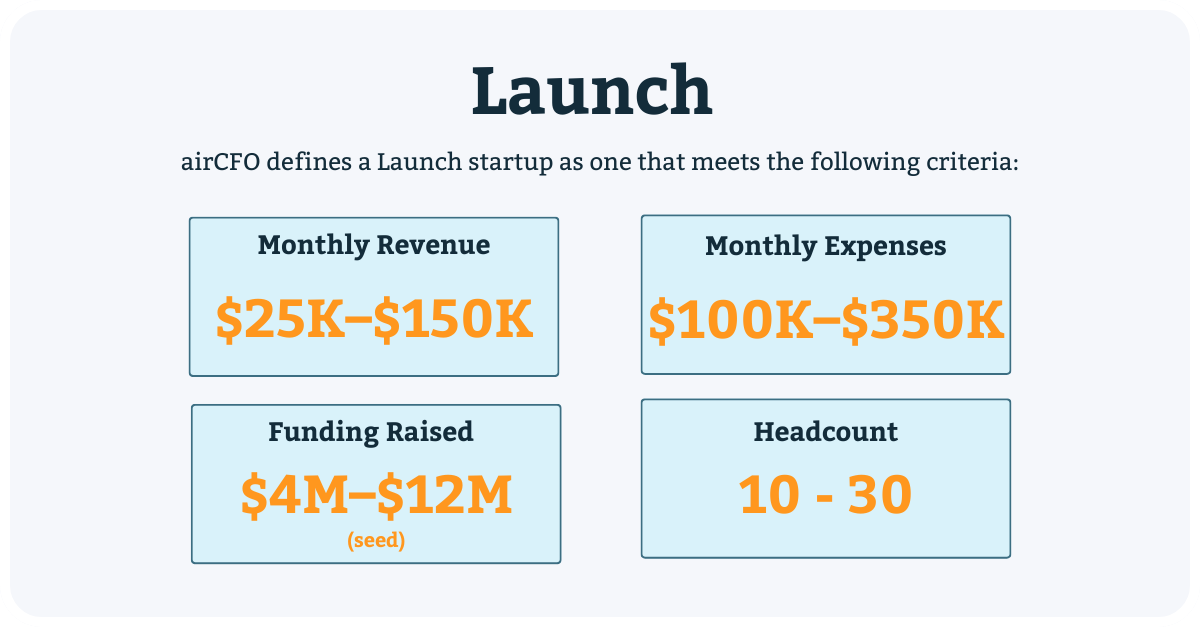
Fast-forward 30 months, and ai.CFO has reached a significant milestone in their journey - they’ve successfully launched their MVP and validated with a group of pilot customers. It was hard work, but it paid off, as they've secured $5 million in seed funding from VCs and angels. This infusion of capital has given the company another 30 months of runway to find problem-solution fit.
The team is now 20 strong, and they continue to onboard new hires to accelerate their progress. Christen leads the fast-growing technical team, which makes up 75% of FTEs. Lionel, recognizing the importance of building a formidable go-to-market team, has brought on two experienced account executives and a growth marketer. He spends most of his time collaborating with these hires to develop a sales and marketing plan that will drive customer acquisition and revenue growth.
To address the company's growing operational complexity, Lionel has engaged a financial services partner that provides accounting services and lightweight FP&A support. This partnership allows ai.CFO to maintain accurate financial records, generate timely reports, and make informed financial decisions while keeping their overhead spend to a minimum.
As ai.CFO moves through the Launch stage, the team faces a brand new set of challenges in managing its internal processes. Lionel finds himself grappling with several pain points:
At this stage, your back-office needs more horsepower to keep pace with your evolving business. You need financials that inspire investor confidence, a flexible model that grows with the company, tax strategies that balance compliance with optimization, and hiring systems that scale without diluting culture.
Our Launch Back-Office Flightplan shows you exactly which systems to prioritize, which mistakes to avoid, and how to build the infrastructure that positions you for Series A.
Lionel and Christen spent 30 months at Launch stage building toward problem-solution fit. They scaled to 20 people, refined their product based on customer feedback, and hit $2M ARR. With clean financials, a compelling growth narrative, and robust internal systems, they were ready for their Series A pitch. Investors saw a team that had their operational house in order and the infrastructure to scale efficiently.
For founders navigating the Launch stage, airCFO provides integrated accounting, finance, tax, and people ops support designed for seed-stage companies—building the systems and reporting frameworks you need to position for Series A.
Example deliverables include:
In the next article, we'll see how priorities shift as ai.CFO enters the Iterate stage, where they'll pursue product-market fit with a Series A war chest and face the chaos of hypergrowth.
Please provide a few details about yourself before accessing this resource
Check out these additional resources for actionable tips and insights to guide you through your startup journey.
Practical, tested playbooks for navigating startup finance in the age of AI, from the frontlines.
Delivered straight to your inbox, every two weeks.
✍️ Written by Alex Wittenberg, CEO of airCFO

Partner with us to simplify your back-office and focus on what matters most: growing your business.

.png)