A 4-part series on why startups break at predictable moments—and how to prepare.
Imagine this: You're in mission control moments before a rocket launch. The air is thick with tension. Finally, the rocket lifts off. Cheers erupt when it clears the launchpad.
But at that moment, the crew's journey is just beginning. Mission control stays dialed in, monitoring every system and potential failure point to keep the rocket on course.
Your startup is that rocket. And just like any successful launch, you need mission control - your internal operations team - keeping the back-office running smoothly, people systems humming, and compliance shields intact. A great back-office is just as critical to startup success as product development or sales.
Over the past decade at airCFO, we've served as mission control to hundreds of startups who have raised over $15B in VC funding. We've seen them all face the same growing pains as they evolve from a scrappy crew into a full-fledged operation.
Each startup goes through four distinct stages during their growth journey. We've named these stages: Launchpad, Launch, Iterate, and Scale.

In this series, we're walking through what founders face at each stage: what it actually feels like, why certain challenges hit when they do, and how to navigate them. Find where you are in the Flightplan, and you'll know what to focus on now and what's coming next.
But before we jump into the story, here's what you need to know: as rockets accelerate through the atmosphere, they hit predictable pressure points. Most crews don't prepare for them and that's when systems start to break.
As Hiroshi Mikitani, CEO of Rakuten, famously said, startup systems tend to fail based on "The Rule of 3 & 10":
When you go from one person to three people, everything changes. At 10 people, everything changes again. The same happens at 30 and 100 people. At each of these thresholds, your communication systems, payroll, accounting, customer support - everything you've put in place - needs to evolve.
Mikitani's observations ring true in our experience building startup back-offices. We actually discovered this 'rule' while researching this piece and realized we'd been building our four-stage Flight Plan framework around these same milestones for years without knowing it.
So what causes these breaking points? The answer might lie in Metcalfe's Law. This law of network theory states that the number of connections between nodes in a network grows exponentially as the network grows in size.
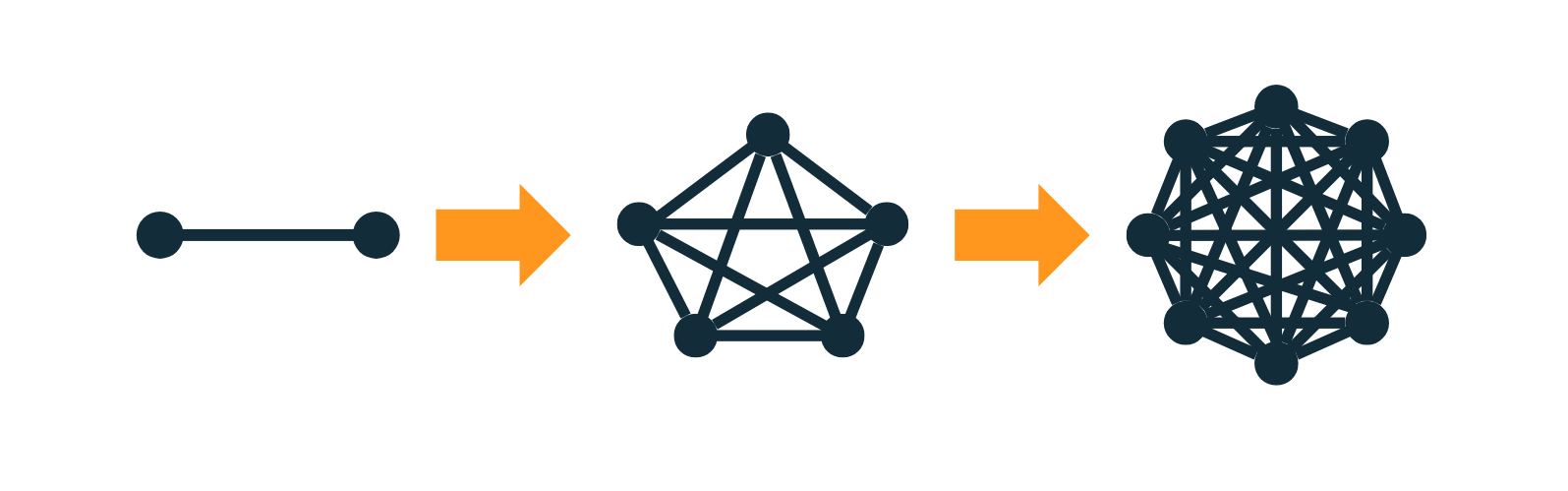
Metcalfe’s law has been the driving force behind many of today’s most successful tech companies, but it has a dark side. As your team grows, the connections between people multiply exponentially and so does the complexity of your operations. This complexity can overwhelm systems and processes that worked well at earlier stages, leading to breakdowns and inefficiencies.
That's why it's so important to proactively plan for these transitions and build scalable, adaptable infrastructures from the start. As Bill Hewlett, co-founder of HP, put it: "More startups die of indigestion than starvation." It's not about having enough resources, it's about being able to deploy them effectively as you grow.
That's where this Flightplan comes in. By understanding where you are in the journey and what's coming next, you can:
Over the next four articles, we'll follow Christen and Lionel: two former VPs who just raised $1.5M to build ai.CFO. They've got 20 months of runway and a problem to solve. We'll show you what each stage feels like in real time, the mistakes founders commonly make, and the operational moves that keep you on trajectory.
Ready for liftoff? In Part 2, we'll start at the beginning. Meet you at the Launchpad.
A Note on Your Journey: This framework represents a typical trajectory for venture-backed startups, but your path may look different. Industry (SaaS vs. BioTech), business model (B2B vs. B2C), and funding strategy (bootstrapped vs. venture-backed) all influence how quickly you move through stages and which challenges you face.
Use this as a guide, not a rulebook. The most successful founders anticipate change, adapt quickly, and build systems that can withstand the challenges of rapid growth while staying flexible enough to chart their own course.
Please provide a few details about yourself before accessing this resource
Check out these additional resources for actionable tips and insights to guide you through your startup journey.
Practical, tested playbooks for navigating startup finance in the age of AI, from the frontlines.
Delivered straight to your inbox, every two weeks.
✍️ Written by Alex Wittenberg, CEO of airCFO

Partner with us to simplify your back-office and focus on what matters most: growing your business.

.png)
.png)
.png)