|
Over the past three months, I've had two full-time jobs: leading airCFO into the AI era, and renovating the house my girlfriend & I purchased in East Austin. And honestly, the home renovation has felt like the harder of the two at times 😭 I'm happy to report that the renovation is 95% complete, and my home office is finally operational.
We're also in the process of making major renovations to airCFO's finance offerings. My mandate to the team: forget everything about how we've historically supported our clients & imagine what a truly AI-powered finance service might look like in 2027. We have the opportunity to take a major leap forward by shedding our priors & leaning into the power of the new tools at our disposal.
In today's essay, I wrote about the tool the rest of our services hang off of: the financial model. We're all figuring this out in real-time, so please shoot me a quick email if you have any feedback/reactions! I reply to every message.
|
💡 TL;DR
- I wrote 32,000 lines of code trying to kill our financial model template with a webapp. Spoiler alert: I ended up killing the webapp instead.
- I landed on a hybrid model instead, and I believe our 'spreadsheet sandwich' could be finance professionals' best-of-both-worlds financial modeling approach.
- Other things on my radar: the signal in Airtable's $1.3B exit, the democratization of finance work being brought about by AI, and my new Funded conversation with Nick Tippmann about all things vertical SaaS.
|
Will AI kill the spreadsheet?
A year ago, in my very first AI CFO essay, I wrote that vibecoding is "the next Excel," the defining skill for the next generation of finance operators. I believed it so much that I set out to kill our company's spreadsheets.
My initial target? airCFO's financial model template. The plan seemed like a no-brainer: rebuild our outdated, bloated financial model as a modern webapp.
Three months and 32,000 lines of code later, I shut the project down.
Today, I'm more excited about our upcoming new-look financial model than I ever was about the app. Because the financial model of the future is still a spreadsheet. Just not the kind of spreadsheet you're used to.
The Financial Vibecoder's White Whale
Our model template is the beating heart of airCFO's advisory work, and it's a beast: roughly 28 tabs, a 35-step checklist to configure for each new client, formulas that cascade into #REF! errors if you look at the structure wrong, and no record of who changed which assumption when. Every client model starts life as a copy of the template and immediately begins drifting away from it.
We've lived with these limitations for a decade. So when I learned to build software with AI, rebuilding the financial model became my white whale.
I Actually Built the Thing
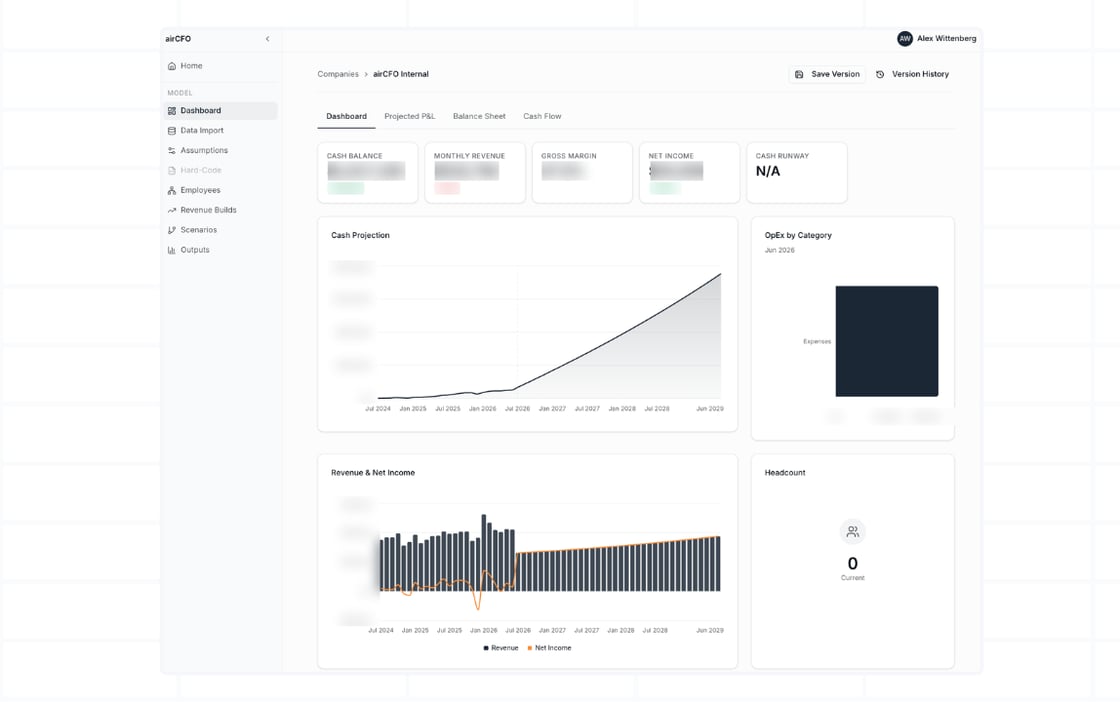
I spent three months and thousands in (heavily subsidized) tokens building a prototype: a full three-statement projection engine, connected to our back-office systems, complete with headcount planning, scenario toggles, logins and permissions for multiple team members. Investor-grade outputs. Clean UI.
And it worked… sort of. But as I got closer to the finish line, I learned a few hard lessons about ‘free solo’ vibecoding:
- Building a webapp is a single-player game, but running a financial model is multiplayer. Any finance professional on the planet can open a spreadsheet, click into a cell, and trace a formula. Exactly one person on the planet could troubleshoot my webapp, and he has a company to run. It would've been prohibitive to train my team of nontechnical finance pros to maintain a custom codebase.
- End users demand traceability. When a founder sends their model to an investor, "trust me, the code is right" does not fly. Diligence teams want to double-click into the revenue number and follow it all the way to its source. A spreadsheet gives you that for free. I was going to be building audit-trail features one at a time, forever.
- Modeling runs on one-off overrides. "Hardcode in a jump in expenses for next month's offsite." "Let's increase our conversion assumption for our launch, but vary the percentage bump & launch date in each scenario." In a spreadsheet: click, type, done. In a webapp: write code, review it, deploy it. Even when Claude writes the code, shipping a deploy to change a single number is silly.
The Final Straw
Somewhere in month three, I noticed that two different screens were each recognizing a different month as ‘Latest Actuals.’ The dashboard thought it was June. The assumptions page voted for May.
I pushed three commits to solve it. But even once it was solved, I reached my tipping point. My state-of-the-art financial modeling platform could not be relied upon to answer the question "What month is it?"
In a spreadsheet, the date is one cell. Every other formula just points at it.
That's when I knew the webapp experiment was DOA.
The Journey is the Destination
I don't regret shipping those 32,000 lines (at least not entirely). Building the app is what showed me which parts of a financial model actually belong in code, and which parts should never leave the spreadsheet.
The spreadsheet is unbeatable at exactly the things my app was worst at: transparency, auditability, hand-tuning, and being operable by any finance professional. Meanwhile, the app did things that spreadsheets never could: version control, automated testing, live data integrations, documentation that stays current.
Spreadsheets aren't missing calculation power. They're missing engineering discipline. And webapps have all the discipline in the world, but they can't win trust.
So the answer isn't choosing one or the other. It's a hybrid: a spreadsheet-based calculation engine, wrapped in a code-based platform.
|
"Spreadsheets aren't missing calculation power. They're missing engineering discipline."
|
Spreadsheet Sandwich
Once I stopped trying to choose, I went back into building mode. Here's what a hybrid model looks like in practice:
The model is defined in code, then generated into a spreadsheet, the same way a program gets compiled from source. The structure, formulas, and logic live in a repository; the spreadsheet is built from that definition, identically, every time. No more 35-step checklist.
The sheet is where the model runs. It's where analysts work, where assumptions get tuned, where a founder's diligence team traces every number. The one-off override can still live in a cell, without having to be deployed.
Code becomes the build system around it. Every change to the model's structure is tracked and run through an automated test suite before it touches a client. (Yes, unit tests for a spreadsheet.) That way, we know the balance sheet is balanced on every single change, instead of just hoping it is.
Code is also the layer on top. It gives founders and investors clean dashboards and views, reading straight from the sheet's published outputs rather than parsing through the entire beast of a spreadsheet.
That's the platform: every property of modern software, built around a spreadsheet instead of replacing one.
Onboarding your AI Analyst
If you've tried dropping a hand-built financial model into Claude, chances are you came away frustrated & disappointed. It can read your formulas, but it can't understand your intent. Ask it to explain any number and it will give you an answer that is possibly correct, but is definitely devoid of context.
A generated model is machine-legible by design: every input, calculation, and output lives in a named, documented range that Claude can navigate like an API.
Ask "why did gross margin dip in Q3?" and the AI can trace the answer exactly the way an analyst would, in seconds. Combine this capability with a thorough context layer (a topic for a separate essay) and you've got yourself an AI financial analyst.
Your Move
We're deep into rebuilding our financial model on this infrastructure at airCFO. Over the next few months, we'll begin generating models through a set of scripts, testing them like production software, and making them readable by Claude. I'll continue to share what we learn as we ship it.
What I can say right now is that our work is uncovering a new set of interesting questions that finance professionals will have to grapple with as they make this transition:
- Where exactly is the line between what belongs in code and what belongs in the sheet?
- What should version control look like for a finance team that has never heard of GitHub?
- How much of an analyst's work can AI do once the model is fully machine-legible? (My initial hunch: a LOT)
In the meantime, I want to hear from you. How are you actually using AI on your models? Reply and let me know if you think we're on the right track!
Bending Spoons is Buying Airtable: Airtable sold for $1.3B, down from an $11.7B valuation in 2021, and everyone is taking this as further evidence that SaaS is dead. The detail I think most people missed: Airtable's AI product, Hyperagent, was carved out of the deal into a separate company before signing.
The company had $965M in cash, so it didn't have to sell. It looks to me like leadership decided the AI bet was the real business and that the cleanest way to double down was to sell the rest rather than restructure around it (and lay off most of their team themselves).
OpenAI: How AI Is Expanding What People Do at Work: OpenAI looked at 800,000 work chats and found that 43.5% of specialized messages are about somebody else's job. Interesting stat: "financial calculation" is a top-three borrowed task for every single other occupation they studied. Your team is already taking finance work into their own hands. The finance function needs to take control to ensure everyone is working from a single ground truth.
A Masterclass in Vertical SaaS: Nick Tippmann, TipTop VC: In the latest episode of Funded, Nick & I covered a wide range of interesting topics: how he evaluates founders, how he advises founders to price their vertical AI products, & why he doesn't buy the fear that AI labs will eat every startup.
That's all for this edition of The AI CFO - we'll be back in your inbox soon with more musings on the future of AI-powered finance & operations. Please reply to this email directly with any feedback/suggestions/just to say hi!
Cheers,
Alex Wittenberg, CEO @ airCFO
|


.png?width=800&upscale=true&name=Heading%20(5).png)
.png?width=1120&upscale=true&name=Spreadsheets%20vs%20Webapps%20%E2%80%94%20Venn%20(1350x1080).png)