|
Last week, I interviewed Ali Esfahani, the CFO of Unconventional AI, a startup (and airCFO client) that raised $475M to build a new, hyperefficient chip architecture modeled after the human brain. It sounds like a crazy idea, but they have a killer team and are already making major progress.
His experience building Unconventional’s finance team felt too familiar to me: he’s built multiple internal-facing applications and a whole team of agents that he leverages to do the work of an entire finance team on his own. He used a term that struck me right to my core: he described himself as an AI Zombie.
After hearing this label, I immediately recognized that I also display the symptoms of an AI-pilled zombie. I’ve spent many late nights with Claude, maxing out my Max plan every 5-hour cycle, and waiting for my weekly limit to reset every Friday at 11AM. I’ve built dozens of applications to solve my daily pain points, both at airCFO and in my personal life. And I occasionally lie in bed unable to sleep, my mind racing, trying to make sense of the current moment and where it’s heading.
I’ve started an Apple Note to capture my thoughts when I’m in this state of artificial insomnia. This week, I'm sharing some of my field notes from the front lines of navigating a 70-person company through the AI wave.
|
TL;DR
1,020,731 lines of code, 35 Cowork Skills, and a lot of sleepless nights. Notes from the front lines of retooling a 70-person company around AI. (Writing code got easier. Almost everything around it got harder.)
Plus
On 10/28, I’m going live with Mercury’s controller to walk through how her team is handing core workflows to AI. Save your spot →
|
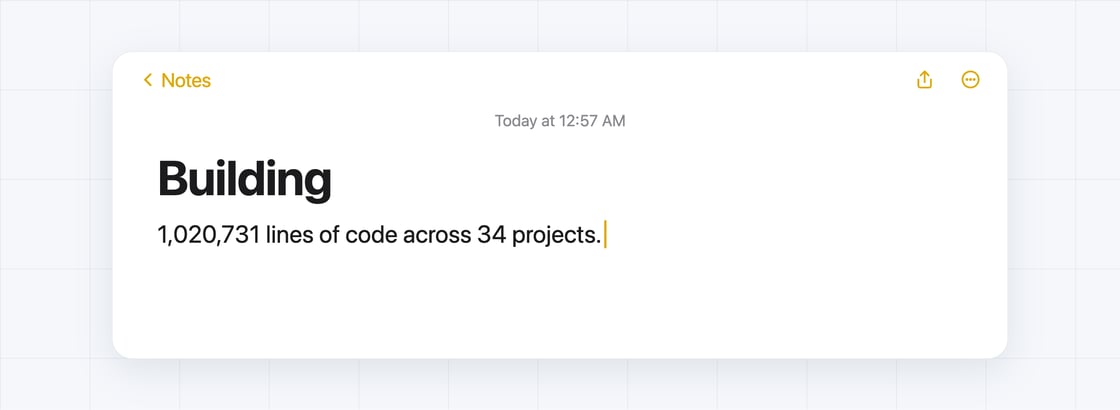 |
- airCFO’s Product team is 1.5 engineers, 1.5 PMs, and 3 AI builders (including myself). I am confident that a team this size supercharged by Claude has the capacity to write all the code airCFO will ever need.
- We built our engineering function with Claude Code as a first-class participant from Day 1: our codebases have self-maintaining documentation & self-contained product roadmaps, our CTO wrote detailed conventions that our coding agents adhere to, and every PR goes through AI code reviews (risky changes get a human review).
- Our AI builders don’t have engineering backgrounds, but they have a deep understanding of our team’s pain points, and AI coding tools allow them to build useful products at a speed that would’ve been unthinkable if they’d had to funnel that understanding through a PM to an engineer.
- Every time a new coding model launches, I pressure-test it through what I call a ‘hackathon sabbatical’. When Claude Code was first released, it felt like an overeager engineering intern. You could build a shiny prototype in minutes, but the code was sloppy, and the agent often slipped into doom loops. Today, shipping a feature feels like directing a pod of highly competent, infinitely diligent, senior engineers operating at 10x speed. My engineers leave far fewer comments on my Claude-assisted PRs, especially once we put a system of team-level guardrails in place.
- But while writing code has gotten easier, the other parts of building a product have gotten MUCH harder. Building product feels like building on quicksand: the landscape is changing so quickly that anything we build could be obsolete in months. We shipped a financial analysis tool in March that had to be completely rebuilt when Opus 4.7 launched in April.
- We’re shipping new features to our internal platform weekly, but our users (airCFO team members) are overwhelmed by the constant stream of updates, & change management has been a nightmare.
- I have personally used Claude to generate 1,020,731 lines of code across 34 projects. Much of that code has been abandoned or is no longer being maintained. As Bret Taylor likes to say, “Software is like a lawn, you have to water it.” This is a lesson I’m trying hard to internalize, but often failing at.
- AI-powered coding is a slot machine that pays out in working code. It feels incredible, but I’m constantly needing to remind myself that I should be using Claude to become a 10x CEO vs. a 1x software developer.
|
“AI-powered coding is a slot machine that pays out in working code.”
|
 |
- When used mindfully, AI can be a fantastic thought partner, a diligent researcher, and a superhuman synthesizer. Previously, I’d spend a few days on a strategic analysis or project plan; with Claude, I can build something higher-quality in just an hour or two.
- There are several little prompting tricks that I use when I’m trying to have Claude bring out my best thinking:
- Inviting pushback, having Claude take the other side of an argument
- Having Claude interview me
- Sometimes, you can unblock yourself just by asking Claude “OK, what should I do next? Give me 3 options”
- But when AI is misused for thinking, it creates slop grenades, and fighting slop is a daily struggle when you’re pushing your team to level up with AI.
- You can work hard on a writeup yet still end up with a slop grenade. When you’re deep into working on a complex project with Claude, it’s difficult to maintain the theory of mind necessary to share effectively with teammates. I call this AI vertigo - it’s not quite AI psychosis. It’s the tension that emerges when the ceiling rises on the ground you can cover in a working session, then you try to compress that session down into something a teammate can digest.
 |
- When systems are set up correctly & team members are bought in, AI really can be a massive accelerator. I’ve watched individual team members flip the switch, figure out how to use AI, and start producing the output of 3 or more individuals, and at a higher level of quality.
- We’ve built our own library of 35 Cowork Skills, distributed via plugin, that allow team members to perform common tasks like providing a status update or prepping for a meeting with a single command. Team members are using these skills every day, and they’re resulting in better meetings, more thorough status updates, and increased team alignment.
- But not everyone is moving at the same speed, and the discrepancy between those who use AI & those who don’t creates a huge imbalance within our org. The AI-powered individuals at airCFO are driving the overwhelming majority of the output while others are still moving at 1x speed. This makes collaboration between the two groups extremely difficult.
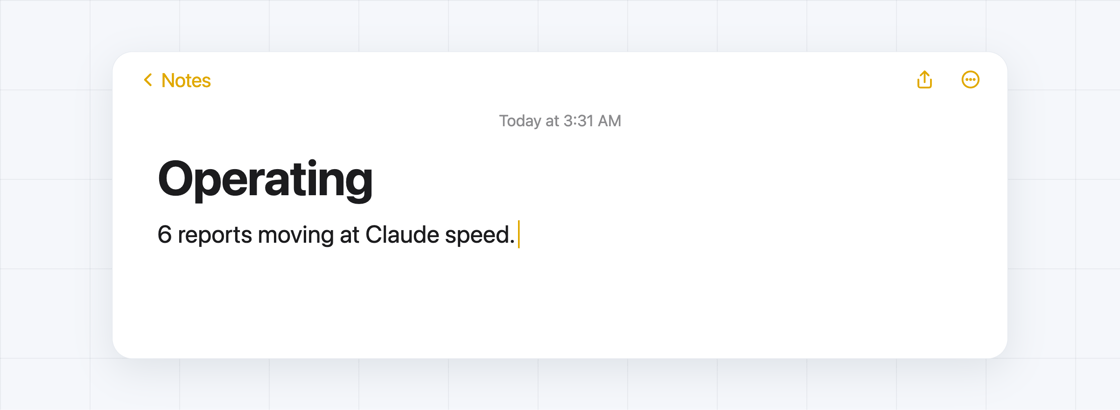
- There’s also a double-edged sword to AI-enabling my direct reports; they are more productive (which is great!), but when you have 6 reports moving at Claude speed, you end up with more work than in the pre-AI world. Despite my own productivity gains, I find myself increasingly sitting as the bottleneck for my team.
- Throughout our entire AI enablement journey, we’ve been determined to build AI that augments our humans instead of replacing them. This is still our goal, but we are starting to automate tasks that many people see as core to their roles, and that is scary for many of them. And sometimes, it feels like the optimistic framing falls on deaf ears.
 |
These notes are a snapshot of where we stand in our AI enablement journey as of today, at the beginning of what we’re calling Phase 2. Our team’s AI adoption has increased massively over the past 12 months, and I’m encouraged by many of the results. But now our challenge is dealing with the second-order impacts of strong AI adoption, especially the dichotomy that’s opened up across airCFO.
Phase 1 was about experimentation and lighting small fires with individuals. Phase 2 requires that we reconfigure the way airCFO runs to put AI at the center of our operations. We’ve developed a context store that is actively capturing our team’s collective knowledge, and in the coming months we’ll be rolling out a platform that leverages this knowledge to turn every team member into an AI power user. By the end of 2027, airCFO’s humans & AI agents will collaborate seamlessly on top of a shared data foundation, and we’ll be able to call ourselves an ‘AI-native services firm’.
There will likely be many more sleepless nights between here & there, but they’ll be (mostly) driven by excitement for the future.
📡 On My Radar
(Article) You Need a New CFO
a16z argues the CFO is going from scorekeeper to designer of the company’s operating system. It reads a lot like the Business Performance Architect thesis I laid out earlier this year. But it never answers the question most of you probably have: what if you don’t have a CFO yet? This is the solution we’re trying to build within our services.
(Podcast) Every CFO Needs an Engineer (Ali Esfahani, Unconventional AI)
Funded is now The AI CFO podcast, and our first guest was my fellow AI Zombie. Ali & I talked about why every CFO should have a software engineer, why seat-based pricing is on borrowed time, & how he thinks about building tools for his finance function.
(Webinar) The Startup Operator’s Playbook for AI in Finance
Every finance professional is using AI by now, but few have been able to rethink their workflows with AI at the center. I’ve watched Mercury make this transition over the past 6 months, and on 10/28 (12 PM PT), I’m chatting with their controller Christine Andrews to get the inside scoop. We’ll go step-by-step, from one-off chats all the way to a full handoff of core workflows to AI. Can’t make it live? Register anyway & we’ll send the recording. 🙌
That's all for this edition of The AI CFO - we'll be back in your inbox soon with more musings on the future of AI-powered finance & operations. Please reply to this email directly with any feedback/suggestions/just to say hi!
Cheers,
👋 Alex Wittenberg, CEO @ airCFO
|


.png?upscale=true&width=800&upscale=true&name=Heading%20(5).png)