|
It's been a crazy couple weeks in AI Land - agentic swarms are executing self-motivating hacks of unicorn startups, model lab CEOs are unifying around a call for 'pacing the frontier', and data centers are becoming topic #1 for the midterm elections this fall. The scale & scope of these issues makes it difficult to zoom all the way in to the Office of the CFO, but I'm doing my best!
A few weeks ago, AI consulting & media shop Every launched an essay series called Thesis Statements, asking founders to make predictions about the post-AI future of work. I wrote up my own submission, and below is an expanded version: 'Every software company will become a service company', based on our work with 300+ startups @ airCFO. Would love to hear whether you agree or disagree!
|
💡 TL;DR
- Software has always left the ROI risk with the buyer. Agents change that. Once a vendor is selling the work itself, the result is theirs to answer for.
- The winners will be the ones who put people next to the product. My prediction is that by 2027 the services label stops being a penalty and starts being a premium.
- On my radar: Aaron Levie on reinventing yourself in the AI age, plus the Puzzle news, with Sasha saying the next version puts software & services under one roof.
|
Every Software Company Will Become a Service Company
For the last 30 years, the world's biggest businesses were created by selling (and in the SaaS era, renting) software. Software makes a great business model because it is infinitely scalable: you build the thing one time, and then you sell it to a million customers with minimal incremental cost.
In the AI era, however, the software business model has begun to show major cracks:
- Software has become much easier to build, so every space is overcrowded with competitors offering products with undifferentiated feature sets. And when a company can't stand out based on a differentiated product, they need to find another angle.
- On top of this, paying for a subscription license with a login & a customer support portal is a less attractive deal for buyers in a world of AI agents. Traditional software puts the burden of delivering ROI on the buyer; AI startups are promising to deliver the end-state outcome.
But if tech companies are going to sell the work (and capture the value that goes along with that), they need to take accountability for the results. They are essentially selling digital employees, and that requires a much more hands-on approach.
The next wave of world-changing software companies will deploy humans alongside their tools, embedding them with customers to help achieve their desired outcomes. The implementation layer will re-bundle into the vendor.
|
"They are essentially selling digital employees."
|
The Opportunity Nobody is Pricing
Agentic AI is an existential threat to legacy SaaS products, but it's also an opportunity for SaaS to capture 10x more revenue, dollars that currently sit in labor budgets. Here's some back-of-the-envelope math:
- The median company spends about $9,500 per employee per year on software. It spends about $97,500 per employee per year on the employee - a 10:1 ratio. Other published estimates range from 6:1 to 30:1. Software is a rounding error next to the payroll line.
- The vendor isn't going to capture all $10 - the buyer needs to be incentivized to switch. But if an agent can deliver work at half the cost of an employee, the customer gets 50% savings (obviously) while the size of the pie still increases 3-5x for the software company.
- The core strength of the software business model is margins, and delivering agentic AI products will most likely have lower ones than legacy SaaS. But the picture shifts once you stop focusing on margins and start looking at gross profit:
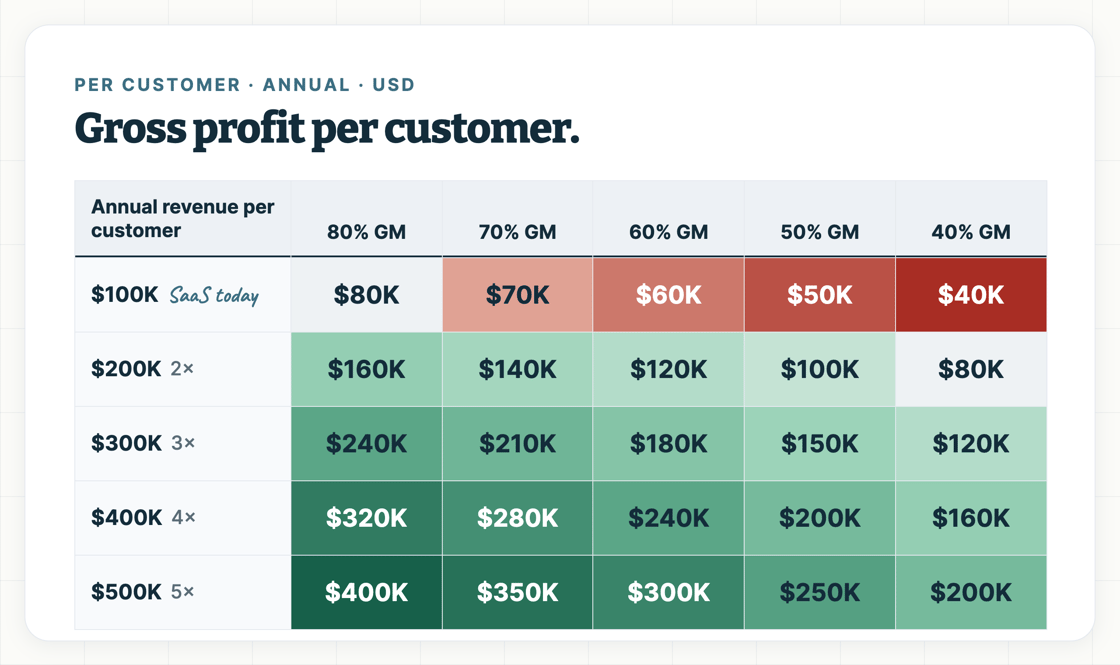 |
Triple the revenue, drop the margin from 80% to 60%, and gross profit per customer still goes from $80K to $180K. At 3x revenue you would have to fall below 27% gross margin before you were worse off than where you started. Accenture runs 32%.
Bigger than Tech-Enabled Services
One important callout: this is so much bigger than 'tech-enabled services'. Services businesses that rely solely on LLMs (or thin LLM wrappers) to bring productivity gains will see margins erode as models improve; the companies that flourish will be ones that create feedback loops that improve their offering.
This means treating proprietary workflow data as a first-class asset, building custom software to level up those workflows, and maintaining a laser focus on solving the end customer's problems. An AI-powered business that customers trust with their most critical workflows will earn the opportunity to build a product that gets significantly better over time.
What Happens Next
Right now the agentic AI market is running on demos and buyers are running pilots, but we've yet to see much measurable P&L impact. This is a capability overhang, not an indictment of the models: the agents haven't been tailored for the specifics of the business, and no one is taking ownership of the outcome.
So over the next 12-18 months, the companies that win will be the ones that ship humans alongside the software.
Better outcomes → better retention & expansion → better case studies → faster growth.
My prediction is that starting in 2027, AI companies will discard the services stigma and get rewarded for it.
📡 On My Radar
(Podcast) Box's Aaron Levie: Reinventing Yourself in the AI Age
Aaron is one of the top (if not the #1) tech company CEOs leading from the front when it comes to AI enablement. His X/LinkedIn posts are always standouts, and this podcast episode is basically a 'greatest hits' compilation of what he's been writing about over the past few months.
(Article) Puzzle Acquired; cites the need to combine services + software
I first met Puzzle's CEO Sasha Orloff back in 2021, when Puzzle was still a BI dashboarding platform, and we worked closely with them as they pivoted to taking on QBO in the SMB accounting space.
This wasn't the outcome their team was looking for, and IMO their problem was structural: it's insanely hard to stand out in the SMB accounting space. Sasha's own reflection post said that Puzzle 2.0 will combine software & services under one roof with Accrual. 🧐
That's all for this edition of The AI CFO - we'll be back in your inbox soon with more musings on the future of AI-powered finance & operations. Please reply to this email directly with any feedback/suggestions/just to say hi!
Cheers,
Alex Wittenberg, CEO @ airCFO
| 


.png?upscale=true&width=800&upscale=true&name=Heading%20(5).png)